
NEWS
BREAKING: PRESIDENT TRUMP FAINTS AGAIN AT THE WHITE HOUSE as White House Doctor Rushes to Attend to Him After Stephen A. Smith Walks Out Following 40-Minute Interview, He Had Been Holding Himself Back, as Cameras and Microphones Were Still Rolling and Captured This

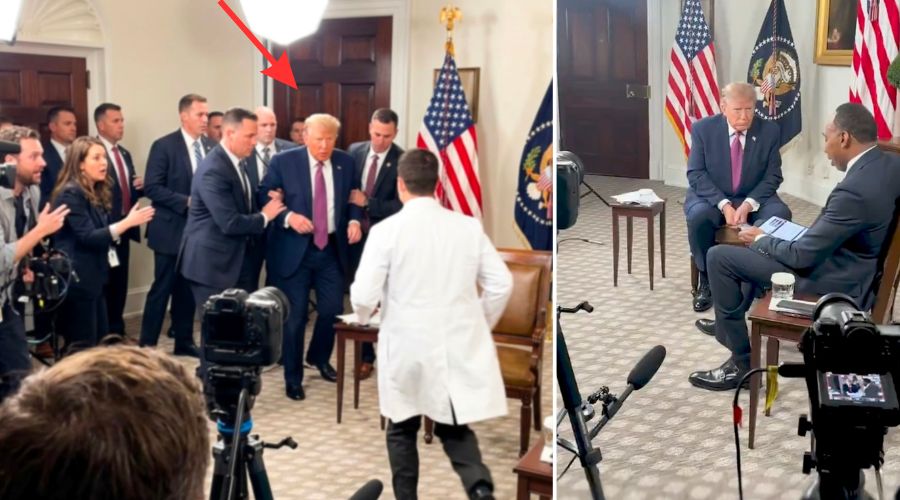
Stephen A. Smith’s White House interview with President Donald Trump took an unexpected turn, as their tense exchange over the midterm elections exposed a difficult moment for the president.
The interview, released Thursday evening through Smith’s YouTube channel, covered Trump’s political leadership, the economy, the midterm results, and his administration’s achievements.
But beyond the political discussion, a dramatic headline has raised questions about what may have happened around the interview’s conclusion.
Claims circulating about a possible White House medical incident have drawn attention, although the interview report itself does not confirm that Trump fainted or required emergency medical attention.
The conversation began after Smith attended a White House dinner as the guest of comedian and political commentator Bill Maher.
Smith later described the gathering as a substantive evening that lasted more than four hours, during which Trump answered questions and responded defiantly to criticism.

That experience provided the background to their televised conversation, where Smith appeared determined to challenge the president about his party’s disappointing midterm performance.
Democrats had secured victories in several places where Republicans had previously enjoyed considerable political strength, creating difficult questions for Trump’s administration.
Smith wanted to know whether Trump accepted any responsibility for those results, particularly because the president had actively campaigned and presented himself as an important figure in the elections.
Trump, however, returned to his familiar argument that he had not personally been on the ballot.

He suggested that the outcome would have been completely different if his own name had appeared, insisting that his presence would have changed the political picture.
Smith continued pressing, attempting to establish whether the president’s decisions and leadership had contributed to the disappointing results.
But Trump repeatedly redirected the conversation towards his achievements, economic figures, polling numbers, and America’s supposed improvement under his leadership.
He also boasted about how international leaders viewed the United States, claiming the country had become powerful and respected again.
At one point, Trump even suggested he would defeat former President Barack Obama in a hypothetical presidential contest in 2028.
Smith tried several times to bring the discussion back to the election, highlighting contradictions in the president’s explanation.
He pointed out that Trump had previously encouraged supporters to treat the midterms as an important judgment on his administration.
Smith also questioned Trump’s complaints about unfavorable media coverage, noting that similar media organizations had existed during previous elections Republicans successfully won.
Despite the repeated questions, Trump remained unwilling to accept the connection Smith was attempting to establish.
As the interview approached its halfway point, Smith appeared increasingly frustrated with the difficulty of getting the president to acknowledge even limited responsibility.
Then came the exchange that would become the defining moment of their conversation.
“You can’t have it both ways,” Smith told Trump, reaching over to touch the president’s knee as he explained the contradiction.
Trump immediately interrupted him with a response that caught attention.
“I can have it both ways,” the president declared.
Smith responded with a brief remark that perfectly captured the unusual nature of the exchange.
“Okay, you’re Donald Trump,” he replied.
Rather than accepting Smith’s argument, Trump moved on to discussing a list of achievements he said had benefited Black Americans.
The moment highlighted the difficulty Smith faced throughout the interview, particularly when attempting to keep Trump focused on questions about political accountability.
The Awful Announcing report described the conversation as an example of how difficult it can be to pin down the president during interviews outside Fox News.
It also suggested that Smith’s preparation was not the problem, but rather the challenge of getting direct answers when Trump preferred moving between different subjects.
However, attention surrounding the interview has also extended to claims about what allegedly happened after the conversation.
A separate headline has suggested that Trump experienced a medical emergency at the White House, with claims that a doctor rushed to attend to him while cameras and microphones were still recording.
Those claims have not been established by the interview report, which does not describe Trump fainting, a medical response, or Smith walking out.
Consequently, the reported medical incident remains a separate claim rather than a confirmed development from the interview.
What the published account does establish is that Smith repeatedly challenged Trump, particularly over the president’s refusal to accept responsibility for his party’s election performance.
The exchange about having it both ways provided a particularly striking illustration of their disagreement.
For Smith, the interview offered an opportunity to question the president about an important political moment.
For Trump, it became another opportunity to defend his record, dismiss criticism, and insist that his administration deserved credit for its achievements.

Jacob Elordi, 29, looks dangerously attractive as he is spotted passionately kissing Jennifer Lopez, 57, in a romantic and intimate beach moment, with Jennifer spreading her legs as they enjoy an unforgettable time together, after his split from Kendall Jenner

BREAKING: PRESIDENT TRUMP FAINTS AGAIN AT THE WHITE HOUSE as White House Doctor Rushes to Attend to Him After Stephen A. Smith Walks Out Following 40-Minute Interview, He Had Been Holding Himself Back, as Cameras and Microphones Were Still Rolling and Captured This

DAKOTA JOHNSON, 37, SPOTTED KISSING MEGAN FOX’S EX-BOYFRIEND MGK, 36, ON THEIR DATE NIGHT IN LOS ANGELES

Pete Hegseth, 46, spotted on a horse-riding date with a mystery 28-year-old woman in new photos after recently awarding a medal to the sentinel who reprimanded him for laughing near the Tomb of the Unknown Soldier on Veterans Day, but one odd detail about their date raises big questions

BREAKING: Trump has completely lost his mind and collapsed during an explosive call with Netanyahu at the Oval Office in the White House after the shouting became too loud. Staff went in to check on him, only for cameras accidentally left running to capture the shocking thing he said before White House staff rushed to attend to him, leaving Americans furious and demanding his immediate resignation

Jake Paul, 29, confesses that he has fallen for his 70-year-old new girlfriend Sheryl Crow after spending one night together, he feels something chasing him and feels like a brand new man, the two were spotted together enjoying a romantic and intimate walk and can’t stop showing his affection for her

Prince William, 44, and Meghan Markle, 45, caught kissing in an intense, intimate moment alongside Prince Harry, 42, and Kate Middleton, 44, raising big questions about Kate’s reaction.

Jensen Huang, 63, caught on camera in an affectionate and intimate moment with Nvidia vice president of healthcare Kimberly Powell, 48, in another extramarital relationship following recent reports of his cheating with alleged Chinese spy Alice Huang

BREAKING: Pete Hegseth has completely lost his mind after an Arlington soldier yelled at his group to “MAINTAIN SILENCE … PAY RESPECT!” because him and his entourage were laughing disrespectfully at the Tomb of the Unknown Soldier on Veterans Day. They turned off the camera but forgot to turn off the microphone, capturing something shocking that will leave veterans and Americans even more ashamed

Jaden Smith, 28, caught red-handed cheating on his 82-year-old lover Michèle Lamy with a 27-year-old mysterious woman in a romantic and intimate moment on a boat, after recently complaining that his 82-year-old lover is too old for him.

Donald Trump spotted fighting for his life as he repeatedly taps his thigh while walking during the 2026 National Veterans Day Ceremony, experts finally reveal the shocking reason, and the reason is so shocking Trump will have to resign.
