
NEWS
New Video Shows Front of Good’s Vehicle — Undercuts ICE Self-Defense Claim

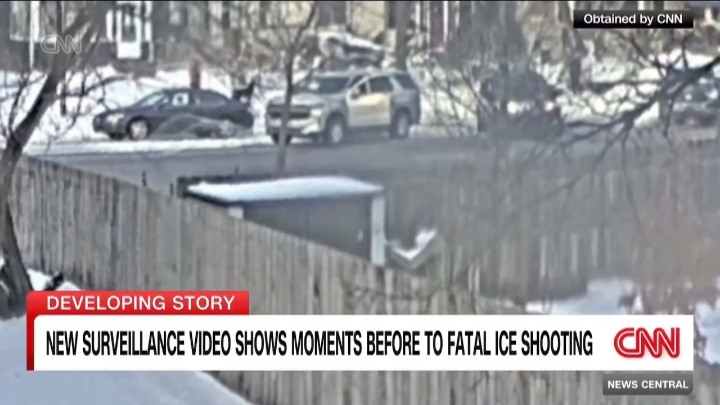
A newly released video has dramatically altered the public understanding of the fatal encounter between ICE agents and a mother identified as Good, providing a clear, unobstructed view of the front of her vehicle at the exact moment shots were fired.
The footage, recorded from a nearby angle not previously available, shows events unfolding in a way that directly contradicts early claims made by federal authorities.
In the video, Good’s vehicle is visibly stationary or moving slowly, angled away from the agents rather than toward them. At no point does the footage show the car accelerating forward or being used as a weapon.
The front of the vehicle is fully visible, and none of the agents appear to be pinned, struck, or in imminent danger. Despite this, an ICE agent positioned in front of the vehicle raises a firearm and fires, fatally striking Good.
Initial statements from federal officials described the shooting as an act of self-defense, suggesting agents feared being run over. That explanation now appears increasingly difficult to reconcile with the visual evidence. The video shows space between the vehicle and the agents, with clear escape routes available. The car’s wheels are turned away, indicating an attempt to leave the area rather than confront anyone.
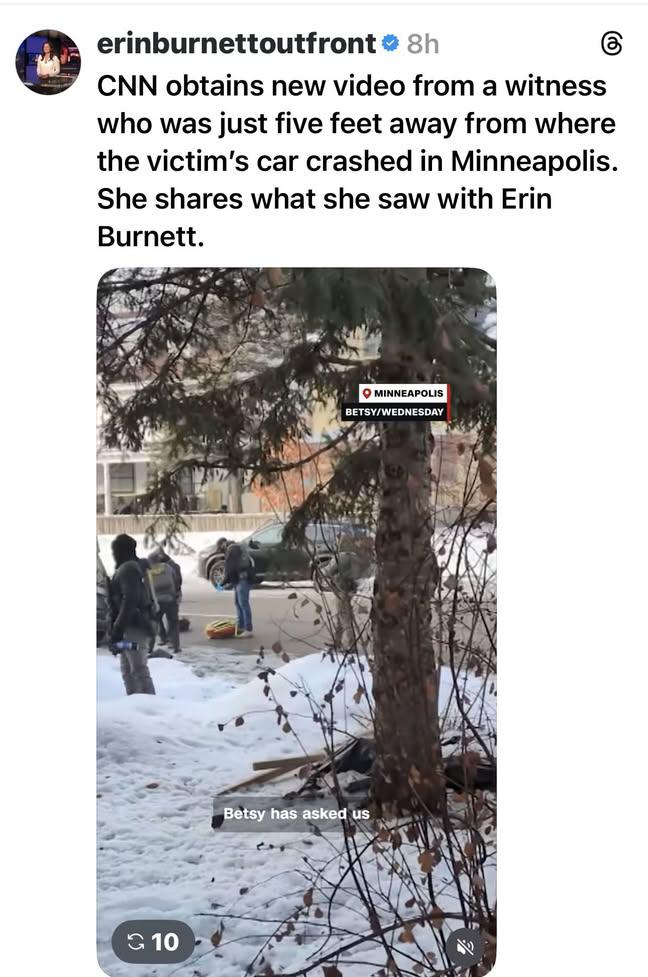
Good had just dropped her child off at school when she encountered the federal operation. There is no evidence she was the subject of an arrest or investigation. She was not armed. She was not fleeing a crime scene. She was a mother navigating a morning routine that ended in seconds with her death on a public street.
As the footage circulates, legal experts and civil rights advocates are questioning how lethal force could be justified under these circumstances. Law enforcement standards generally require an immediate and unavoidable threat to life before deadly force is used. The video does not show such a threat.
Instead, it captures a moment of confusion, fear, and a rapid escalation that left no room for de-escalation.
Community reaction has been swift and emotional. For many, the video confirms what they suspected from the beginning: that Good was not a danger, but a civilian caught in the wrong place at the wrong time. The language being used by critics is stark and deliberate.
They argue that what occurred was not an accident or a tragic misunderstanding, but an execution carried out under the shield of authority.
Federal agencies have continued to defend the actions of the agent involved, emphasizing the tense nature of enforcement operations. However, the growing gap between official statements and the video evidence has intensified calls for accountability. Local leaders have demanded transparency, an independent investigation, and the release of all body-camera footage related to the incident.
For Good’s family, the debate is not abstract. A child was dropped off at school and never saw their mother again. A routine morning became a permanent absence. The video does not show a criminal act. It shows a parent trying to leave.
As the investigation continues, the footage stands as a powerful and unsettling record. It forces a reckoning not only with what happened in that moment, but with broader questions about the use of force, the credibility of official narratives, and how easily an ordinary life can be ended by a single decision.
What is now clear, after seeing the front of the vehicle and the full context of the encounter, is that ICE agents were never facing the kind of bodily harm that would demand lethal force. What remains unanswered is how a mother, engaged in nothing more than the act of dropping her child at school, ended up dead for being in the wrong place at the wrong time.

Rep. Delia Ramirez to Kristi Noem: “Your Department Is Out of Control, and You Are Not Fit to Hold Office” – New Footage of Renee Nicole Good’s Final Moments Sparks National Outrage

Trump’s “Gasception” Moment at Oil and Gas Conference Sparks Viral Reactions and Insider Revelations

New Footage From ICE Agent Shows Final Moments of Renee Nicole Good’s Death in Minneapolis – Sparks Outrage and Questions Over Use of Force

Washington National Opera Announces Exit From the Kennedy Center After 55 Years – As Obama Reacts and Floats a New Arts Center, Trump’s Response Sparks National Uproar
Patrick Mahomes Breaks His Silence as Chilling New ICE Footage Emerges – And the NFL’s Stunning Response Sparks a National Firestorm

Stephen Colbert on the ICE murder of Renee Good: “The message from this administration is clear. Only they determine the truth

Stunning new footage shot by ICE agent who killed Renee Nicole Good shows what REALLY happened, and all the lies have been EXPOSED

A Minneapolis native who visited the protest site near the ICE shooting just gave one of the most clear-eyed, unsettling accounts of what’s actually happening on the ground — and why she believes this tragedy was entirely preventable

New Video Shows Front of Good’s Vehicle — Undercuts ICE Self-Defense Claim

Taylor Swift BREAKS DOWN in Tears After Watching the News With Fiancé Travis Kelce as VP JD Vance Defends the ICE Agent Who Shot a Woman in Minneapolis, Invokes “Absolute Immunity” — But What Comes Next Is What Has America Holding Its Breath

BREAKING: ICE Agent Shoots and Kills Woman in Broad Daylight in Minneapolis — Reports Say Agents Blocked Doctor and Ambulance as Mayor Explodes, Trump Blames Others, Shocking Video Surfaces, and Identities Are Finally Revealed
