
NEWS
BREAKING: Donald Trump has completely lost it tonight and visibly furious as he orders journalists removed from Mar-a-Lago, causing an uproar, but one journalist accidentally leaves his camera and microphone on, capturing Trump’s shocking words that could leave Americans including his supporters extremly furious

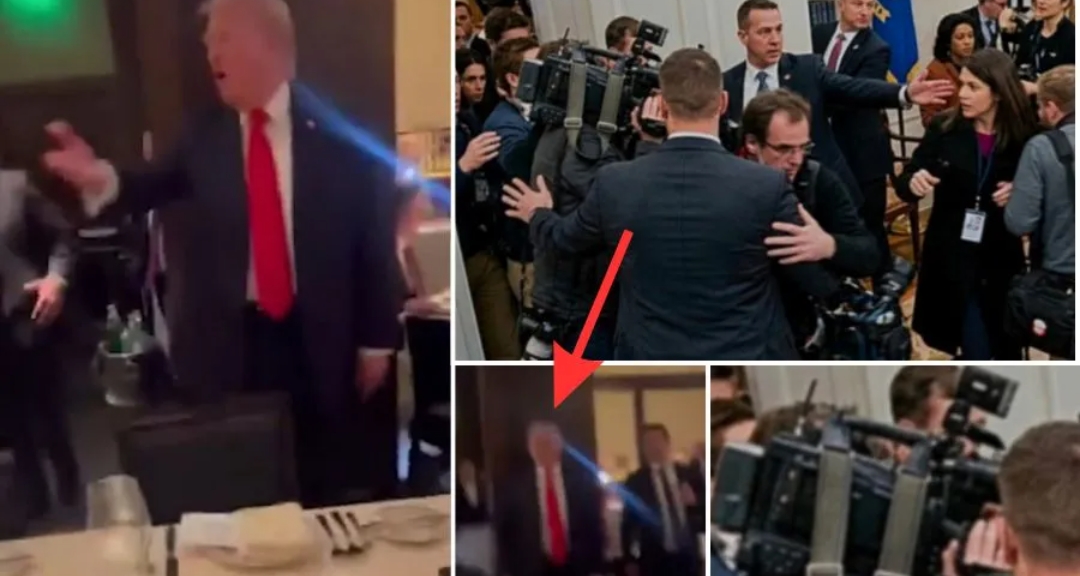
Donald Trump is facing renewed attention after a dramatic confrontation involving journalists at his Mar-a-Lago residence reportedly unfolded, creating an atmosphere of tension and confusion.
The incident allegedly happened during an evening gathering in Palm Beach, Florida, where members of the press were present to cover developments surrounding the president.
What began as an ordinary media gathering reportedly turned uncomfortable when Trump became visibly furious and ordered journalists to leave the property.
The unexpected instruction immediately changed the atmosphere, leaving reporters scrambling to understand what had triggered such a strong reaction from the president.
Journalists who had gathered to document events at the residence suddenly found themselves facing an unexpected confrontation with the president.
The situation attracted attention because journalists play an important role in communicating presidential activities and decisions to the American public.

However, the confrontation reportedly became even more interesting when one journalist’s camera and microphone were accidentally left switched on.
That unexpected detail raised the possibility that the recording could capture words and reactions that were never intended for public consumption.
While other reporters were dealing with the instruction to leave, the recording equipment reportedly continued capturing activity around the president.
The possibility of an uninterrupted recording immediately added another dimension to an already tense encounter.
What made the situation particularly intriguing was the suggestion that Trump’s words could reveal his frustration with the journalists surrounding him.

Presidential interactions with reporters frequently attract attention because they offer opportunities to question the administration about important national and international developments.
Trump has repeatedly experienced difficult exchanges with members of the press, particularly when questions involve controversial decisions and political disagreements.
His relationship with journalists has remained one of the most closely watched aspects of his political career.
Consequently, any confrontation involving the president and members of the media can quickly become a major talking point.
The reported decision to remove journalists from Mar-a-Lago therefore raised questions about what happened before the confrontation and why tensions escalated.
For reporters covering the president, access to important events and opportunities to ask questions remain essential parts of their professional responsibilities.
However, presidential residences also operate under security arrangements, meaning access and recording permissions can be subject to specific restrictions.
This creates an interesting balance between protecting private property, maintaining security and allowing journalists to perform their work.
The situation became even more sensitive because of the alleged recording equipment that remained active after journalists were ordered away.
An accidentally switched-on microphone can sometimes capture conversations that would otherwise remain unheard by people outside the immediate gathering.
Such recordings have previously generated significant public interest when they involve political leaders, government officials and other influential personalities.
The prospect of hearing Trump’s private reaction therefore became another reason the reported confrontation attracted attention.
For Americans following the administration, the most important question is what the recording actually captured and whether the president’s words provide additional context.
The suggestion that his comments could anger even his strongest supporters makes the alleged recording particularly intriguing.
Trump’s supporters have consistently demonstrated strong loyalty, although disagreements can emerge when political decisions or public statements create unexpected controversies.
His critics, meanwhile, frequently examine his interactions with journalists for indications of how his administration handles scrutiny.
An incident involving reporters being ordered out of Mar-a-Lago could therefore attract reactions from different political groups.
Some may consider the confrontation an unnecessary restriction on press access, while others may argue that the president has legitimate security concerns.
Regardless of political affiliation, the circumstances surrounding the recording would be important in determining what actually happened.
The complete audio, its timing and the surrounding conversation would provide essential context before anyone could confidently interpret Trump’s remarks.
Without those details, isolated words or short recordings could easily create misunderstandings about the president’s intentions.
Nevertheless, the reported confrontation highlights the continuing tension between political leaders and journalists responsible for questioning their decisions.
Presidents regularly face difficult questions because their actions can affect millions of people, making transparency an important part of democratic accountability.
At Mar-a-Lago, the reported incident has created another opportunity to examine the complicated relationship between Trump and the American media.
The possibility that a journalist’s recording equipment captured an unexpected exchange only adds another layer of interest to the situation.
Ultimately, Americans will want to know what prompted Trump’s reported anger, what he said after ordering journalists away and whether the recording supports the claims surrounding the confrontation.
Until the complete circumstances are established, the alleged incident remains a reminder of how quickly tensions between the presidency and the press can attract national attention.

BREAKING: Donald Trump looks completely exhausted in Mar-a-Lago situation room after ordering detonation of lead-based explosives in Iowa a day before Thanksgiving

BREAKING: Donald Trump has completely lost it tonight and visibly furious as he orders journalists removed from Mar-a-Lago, causing an uproar, but one journalist accidentally leaves his camera and microphone on, capturing Trump’s shocking words that could leave Americans including his supporters extremly furious

BREAKING: Trump SUDDENLY COLLAPSES AND FAINTS while taking steps down from Air Force One after arriving in Palm Beach TOGETHER WITH wife Melania for their Thanksgiving Holiday at Mar-a-Lago, as bodyguards and Reporters RUSH TO THE SCENE and capture the moment. But One Journalist’s Camera Accidentally Reveals MELANIA’s Reaction Moments Before His Fall, Raising Serious Questions About Why She Did It

BREAKING: President Trump looks completely sick as wife Melania Trump supports him to prevent him from falling while he wobbles down the stairs of Air Force One in Palm Beach for their Thanksgiving break at Mar-a-Lago

Everyone Is Watching Donald Trump and His Family, But the Same Footage Shows Barron Trump in the Doorway Doing Something That Has Many Convinced He Could One Day Become America’s President

BREAKING: Donald Trump looks completely miserable after wife Melania appears to disgrace him during their walk to the Thanksgiving turkey pardoning event, as she is spotted wearing gloves while holding his hand. Cameras then zoom in closely, revealing something terrible they spotted on Trump’s hand. But what shocks Americans even more is what an open microphone captures as Trump angrily grips Melania’s hand, revealing his shocking words that could leave Americans furious

BREAKING: Donald Trump appears completely in love with aide Natalie Harp as they are spotted together on their way to Marine One, before an accidentally switched-on microphone captures their intimate conversation, revealing an unexpected moment a president should never be involved in and raising questions about his immediate resignation
BREAKING: King Charles Abdicates the Throne for Prince William

Hello world

This is Quadri sample post

BREAKING: Donald Trump caught with a strange mould in his mouth at his golf club while watching Fox News, as his aide Natalie Harp slyly adjusts his pants beside him
